

How To Balance Out A Register
A business must remainder cash register transactions at the stop of each day to properly track and tape sales transactions. This as well helps to ensure that cashiers don't pocket a business'southward cash — cashiers must prove out (bear witness that they have the correct amount of greenbacks in the register based on the daily sales transactions) the amount of cash, checks, and charges they took in during the mean solar day.
This process of proving out a cash register really starts at the end of the previous mean solar day, when cashier John Doe and his managing director agree to the amount of greenbacks left in John'southward register drawer. Cash sitting in cash registers or cash drawers is recorded every bit function of the Cash on Hand account.
When John comes to work the next morning, he starts out with the corporeality of cash left in the drawer. At the end of the business day, either he or his director runs a summary of action on the greenbacks register for the day to produce a report of the total sales taken in past the cashier.
John counts the amount of cash in his register as well as totals the checks, credit-card receipts, and store credit charges. He then completes a cash-out form that looks something like this:
| Receipts | Sales | Full |
|---|---|---|
| First Greenbacks | $100 | |
| Cash Sales | $400 | |
| Credit Card Sales | $800 | |
| Store Credit Sales | $200 | |
| Total Sales | $1,400 | |
| Sales on Credit | $1,000 | |
| Cash Received | $400 | |
| Total Cash in Register | $500 |
A store managing director reviews John Doe's cash register summary (produced by the actual register) and compares it to the cash-out course. If John'due south ending cash (the amount of cash remaining in the register) doesn't friction match the greenbacks-out form, he and the manager try to pinpoint the mistake. If they can't notice a mistake, they fill out a cash-overage or cash-shortage form. Some businesses charge the cashier directly for any shortages, while others take the position that the cashier's fired subsequently a certain number of shortages of a certain dollar amount (say, three shortages of more than than $x).
The store manager decides how much cash to leave in the cash drawer or register for the next day and deposits the remainder. He does this chore for each of his cashiers and and then deposits all the cash and checks from the 24-hour interval in a night deposit box at the bank.
The manager then sends a report with details of the deposit to the bookkeeper so that the data makes information technology into the accounting system. The bookkeeper enters the data on the Cash Receipts form (see the following figure) if a computerized accounting system is being used or into the Cash Receipts journal if the books are beingness kept manually.
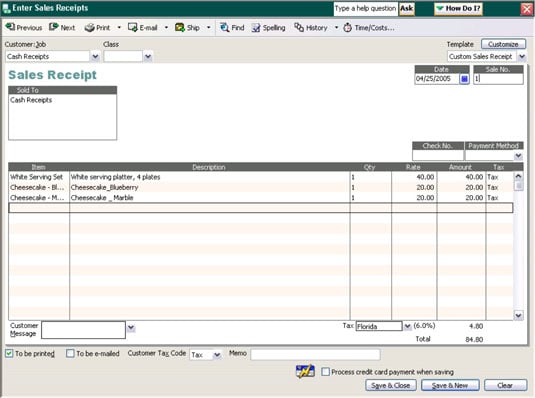
Example of a sales receipt in QuickBooks.
Nigh This Commodity
This article can be establish in the category:
- Bookkeeping ,

How To Balance Out A Register,
Source: https://www.dummies.com/article/business-careers-money/business/accounting/bookkeeping/how-to-balance-cash-register-transactions-189070/
Posted by: lyoncoug1957.blogspot.com
0 Response to "How To Balance Out A Register"
Post a Comment